
Level Chambers
Bypass chambers for external level instrumentation and gauge service.
View Specifications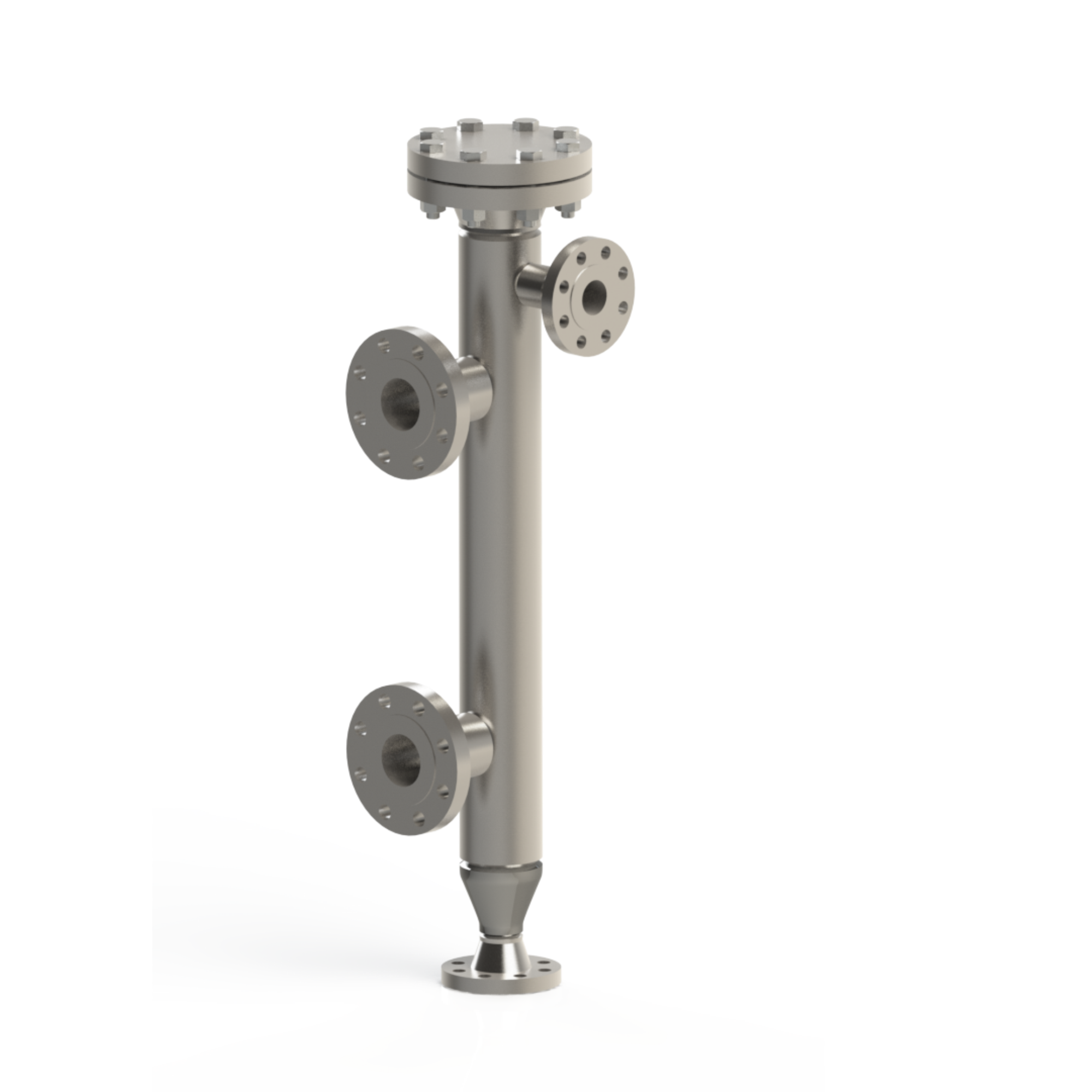
The Level Chamber, also called a Bypass Chamber, is an external vessel that mounts on the side of a process tank, column, or vessel and reproduces the process liquid level in a stable, accessible column. It is connected to the vessel through top and bottom (or side-side) process connections, so the liquid level inside the chamber always matches the level in the vessel. Level instruments such as magnetic level indicators, guided wave radar transmitters, displacer transmitters, float switches, and gauge glasses are mounted on the chamber instead of inside the vessel. This gives easy access for installation, calibration, and maintenance without shutting down the process, and it isolates the instrument from turbulence, agitation, foaming, and internal obstructions. Chambers can be supplied for a wide range of pressures, temperatures, and fluids, including corrosive, high-pressure, high-temperature, and interface services, with isolation valves and drain and vent connections as required.
Bhavyam offers all level chambers and bypass chambers under the BETFITT range of products. Design & engineering is done as per global standards to meet challenging process demands.
Specifications
| Product Type | Level Chamber/ Bypass Chamber |
| Chamber Material | Carbon steel, SS 304, SS 304L, SS 316, SS 316L, Duplex, Monel, Hastelloy, Titanium; and others on request |
| Process connections | Side-side, side-bottom, top-bottom, and others on request |
| Connection size | ½” - 4”; and others on request |
| End connections | Flanged (RF/ RTJ), threaded (NPT), socket weld, butt weld |
| Chamber diameter | 2” - 6”; as per requirement |
| Testing | PMI, Hydrotest, Dye Penetration Test, Radiography, and others on request. |
Applications we serve.
- Boiler drums and feedwater heaters — reliable level indication under high pressure and temperature.
- Oil & gas separators and knock-out drums — level and interface measurement in gas, oil, and water separation.
- Distillation columns, reactors, and process vessels — stable measurement despite agitation, boiling, or foaming.
- Chemical and acid storage tanks — corrosion-resistant chambers in SS, duplex, or exotic alloys, keeping instruments away from the vessel interior.
- Steam and condensate systems — level control in deaerators, condensate pots, and heater drains.
- Cryogenic and refrigeration services — level measurement in LNG, ammonia, and refrigerant vessels, with extended or insulated chambers.
- Interface measurement — oil-water or liquid-liquid interface in separators and decanters.
- Retrofit installations — adding level instrumentation to existing vessels without internal modifications.
Frequently asked questions.
Why use a level chamber instead of mounting the instrument directly on the vessel?
A level chamber lets the instrument be installed, calibrated, and serviced without opening the vessel or shutting down the process, because it can be isolated with valves. It also protects the instrument from turbulence, agitation, foam, and internal obstructions that cause false readings. It is especially useful when a vessel has no suitable nozzle or internal access.
Which instruments can be mounted on a level chamber?
Most common level technologies can be used, including magnetic level indicators (MLI), guided wave radar transmitters, displacer transmitters, float switches, and gauge glasses. The chamber diameter, connection size, and internal arrangement are selected to suit the instrument and the process fluid.
How is the chamber material selected?
The material is chosen from the fluid's corrosiveness, the operating temperature and pressure, and any applicable standards. Carbon steel suits general services, stainless steel (304/316) suits corrosive or hygienic services, and duplex or exotic alloys suit aggressive chemicals or seawater. For sour service or low-temperature applications, materials with appropriate certification (such as NACE compliance or impact testing) are used.
Need help choosing the right configuration?
Share your process data — fluid, line size, pressure and temperature — our engineers respond with a sized, documented quotation