
Cone Meters
With its compact cone design requiring minimal straight-run piping, Cone Flow Meters deliver accurate differential pressure measurement in tight installations, high-pressure lines, and multiphase flows.
View Specifications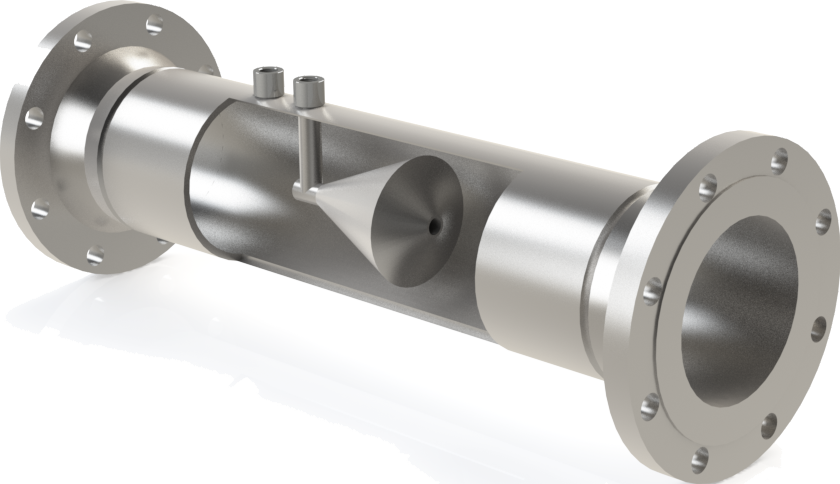
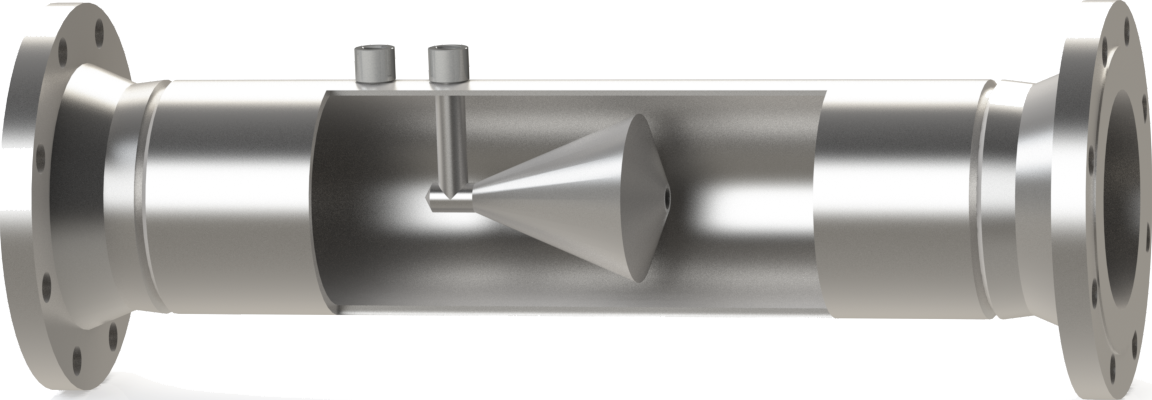
BETFLOW Cone Meter (BF-VM)
The Cone Flow Meter is an advanced differential pressure (DP) primary flow measurement device featuring a unique centrally-mounted, axis-aligned cone element. Unlike conventional restriction meters — orifice plate, flow nozzle, venturi — which restrict flow at the pipe periphery, the cone element is positioned at the pipe centreline, compelling the process fluid to accelerate through an annular passage between the outer surface of the cone and the inner wall of the pipe.
Bhavyam offers all flow elements under the BETFLOW range of products. Design & Engineering done as per Global Standards to meet challenging process demands. Manufacturing all flow metering solutions as per ISO 5167/ ASME MFC 3M/ ASME 19.5/ BS 1042/ AGA 3/ AGA 8/ RW Miller standards.
Specifications
- Cone Material: SS316 & SS316L as standard. SS304, SS304L, Hastelloy, Monel and others on request
- Pipe Material: A106 Gr.B, SA335 P11, SA335 P22, SA335 P91, SA335 P92 and others on request
- End Connection Type: butt weld end / flanged
- End Connection Material: ASTM A105 & ASTM A182 F316 as standard. ASTM A182 F304, ASTM A182 F11, ASTM A182 F22 and others on request
- Testing: PMI, hydrotest, dye penetration test, radiography, flow calibration, and others on request
Applications we serve.
- Applications with limited upstream and downstream straight pipe length
- Low Reynolds number and viscous fluid flow measurement
- Retrofitting flow measurement into existing compact piping
- Wet gas and multiphase flow measurement
- Skid-mounted and offshore metering packages
- Pulsating or disturbed flow conditions downstream of control valves and pumps
- Chemical injection and additive flow measurement
Frequently asked questions.
What is a cone meter and how does it work?
A cone meter is a DP flow element with a cone-shaped obstruction centred in the pipe, which reshapes the velocity profile as fluid flows around it. The pressure difference between upstream and the low-pressure region behind the cone is used to calculate flow rate, similar to other DP elements.
Why does a cone meter need less straight pipe length than other DP elements?
The cone itself conditions the flow as it passes, reshaping a distorted velocity profile into one suitable for accurate measurement within the meter body. This reduces or, in many designs, nearly eliminates the need for long straight pipe runs upstream, which is one of the main advantages of a cone meter over an orifice plate or venturi tube.
How does a cone meter perform with viscous fluids or at low Reynolds numbers?
Cone meters maintain a stable discharge coefficient across a wide Reynolds number range, including low values typical of viscous fluids, making them a reliable choice where other DP elements lose accuracy.
Need help with your flow measurement challenge?
Share your fluid properties, line size, flow rate and operating conditions, our engineers respond with a quotation